Project
Concrete Crack Detection with Grad-CAM
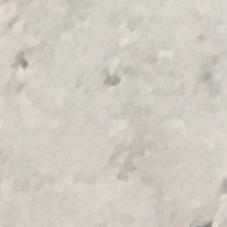
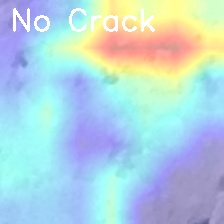
Part of Vveer Motani's portfolio · Robotics & Physical AISee everything →| Original | Grad-CAM | Prediction |
|---|---|---|
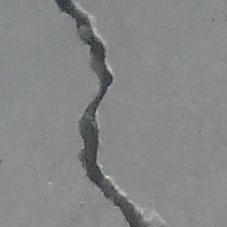 |
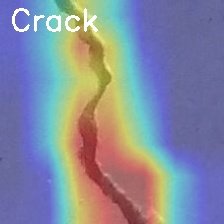 |
Crack |
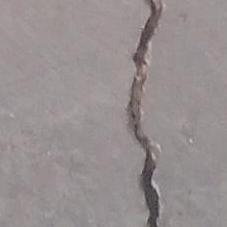 |
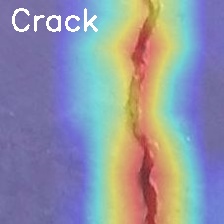 |
Crack |
 |
 |
No crack |
Red marks the regions that most influenced the prediction; blue marks regions the model ignored.
Why Grad-CAM
Training the classifier is the easy part. The harder question is whether it detects cracks or just correlates with something else in the image, such as lighting, texture or background. Grad-CAM answers that by showing which pixels the decision depended on. If the red sits on the crack, the model learned the right thing.
How it works
- Transfer learning. All convolutional layers of a pretrained ResNet-18 are frozen, and only a new head (
nn.Linear(512, 2)) is trained. The pretrained layers already encode edges, textures and discontinuities; the head learns what to look for. - Grad-CAM. Two hooks on the last convolutional block (
layer4[-1], 512 maps at 7×7) capture its activations on the forward pass and the gradients of the predicted class on the backward pass. Each map is weighted by its mean gradient, and the weighted sum becomes the heatmap.
Results
99.51% validation accuracy after 3 epochs on the surface crack dataset (Özgenel and Gönenç Sorguç, ISARC 2018): 40,000 images at 227×227, half cracked and half intact. The dataset is balanced and the crops are clean, so the accuracy says less than the heatmaps do about whether the model would hold up on real inspection images.
Next
Severity classes (hairline, moderate, severe), then running the pipeline on sequential frames from site inspection surveys.